
God can beat Dollar Cost Averaging if...

Few years ago, there was an article that ran an analysis on market timing versus dollar-cost averaging.
The idea was simple: what if you had God's knowledge and you could buy the dip at every single market downturn?
At the end of the day, would you be better off compared to dollar-cost averaging?
The article was first published in 2019. Using the U.S. stock market data spanning from 1920 to 2018 : 98
It's been 8 years, and in fact, the economy back then was fairly different from today. We didn't see as many AI companies. We did not see as much of a boom in the energy and chips companies. Perhaps they were there, but they were mainly private companies.
I'm curious to see how things have changed and whether God can beat DCA.
Thankfully, some data for S&P 500 is available here, thanks to work of good samaritans. The data set ranges from 1871 Jan to 2026 Jun. However, some cleaning was required as it's missing S&P500 dividend and CPI data.
This is the cleaned dataset, you are free to use
I'll be exploring the same thesis as Nick Maggiulli and expanding it further
- Expanded rolling 40 years
- 10 years rolling investment window
- 20 years rolling investment window
- 30 years rolling investment window
I figured it's important to examine different time horizon because not every investor have the same 40 years time frame. Index investing has only been popularised within the last decade along with the boom of ETF. Some started in their 40s, some in their 50s.
Realistically speaking, many people don't have 40 years ahead of them to achieve their investment objectives.
Perhaps we might get a different finding on other time horizon
Assumptions
It wasn't stated in Nick's article. But I would assume
- transaction cost to be negligible
- fractional shares are possible even back in 20th century
- DCA : we will invest $100 every month
- Buy the Dip : we will accumulate cash and invest all of it at bottom
- Interest rate on cash to be 0% (which is not realistic)
- Cash purchasing power remains constant (it wasn't explicitly stated otherwise)
First backtest (Idling cash do not earn interest)
This is the S&P 500 over the last 100 years and the red dot indicates all the trough periods where we will buy the dip.
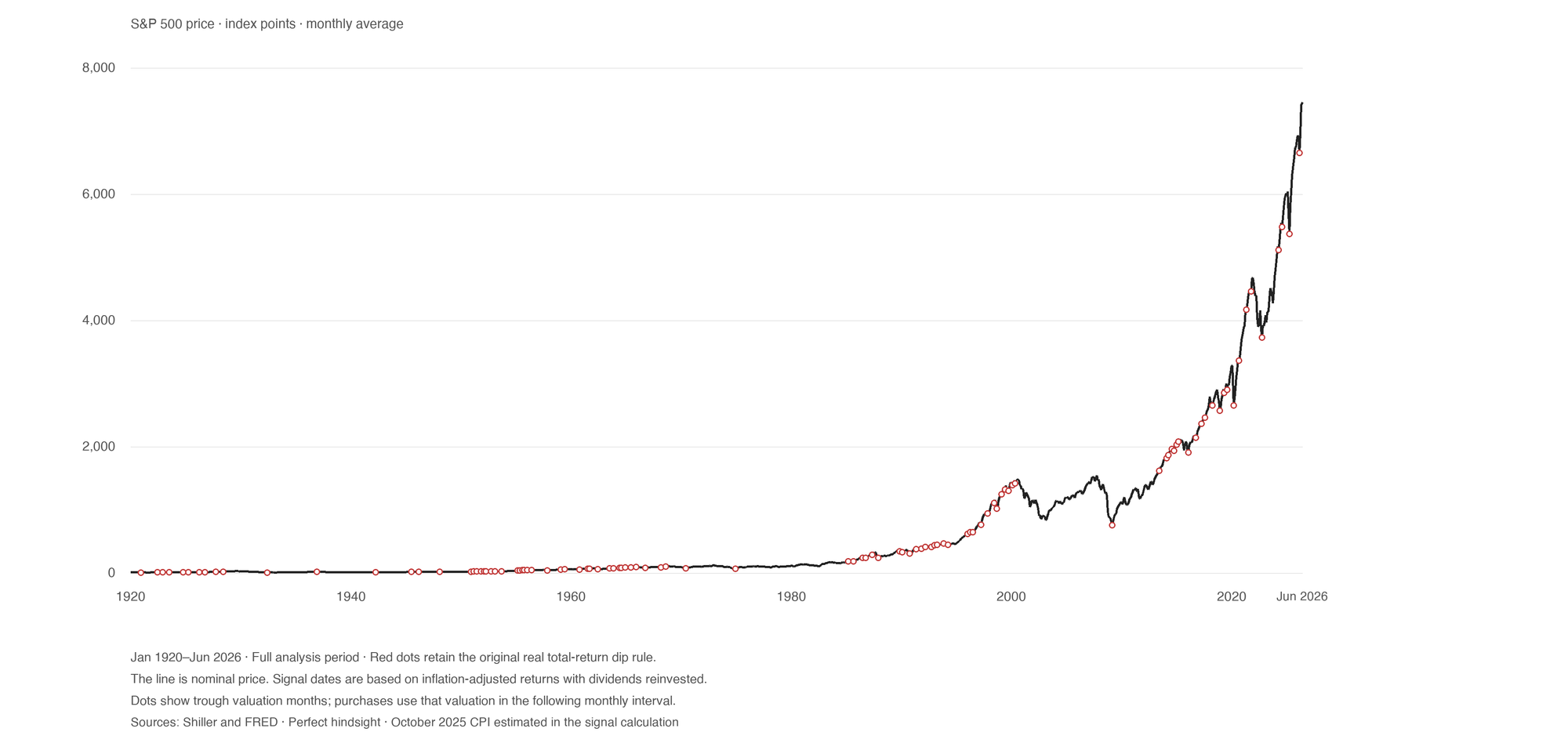
Since god is eternal, god's been investing since beginning and have been for over 100 years.
Interestingly, over the 100 years, buying the dip seemed to outperform dollar-cost averaging. there aren't many 100-year investment outcomes, but this is one of those observations where buying the dip outperforms
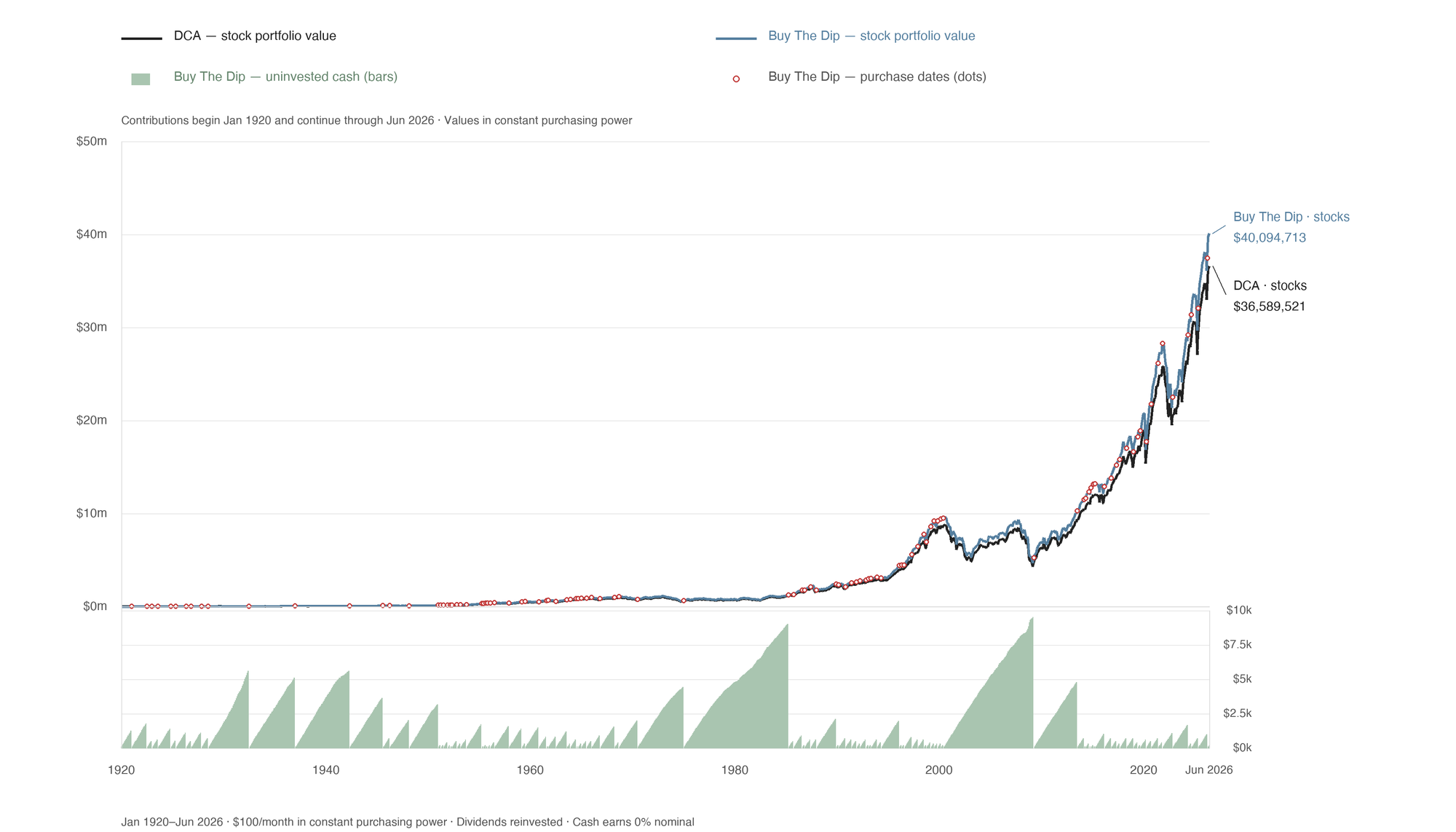
Results
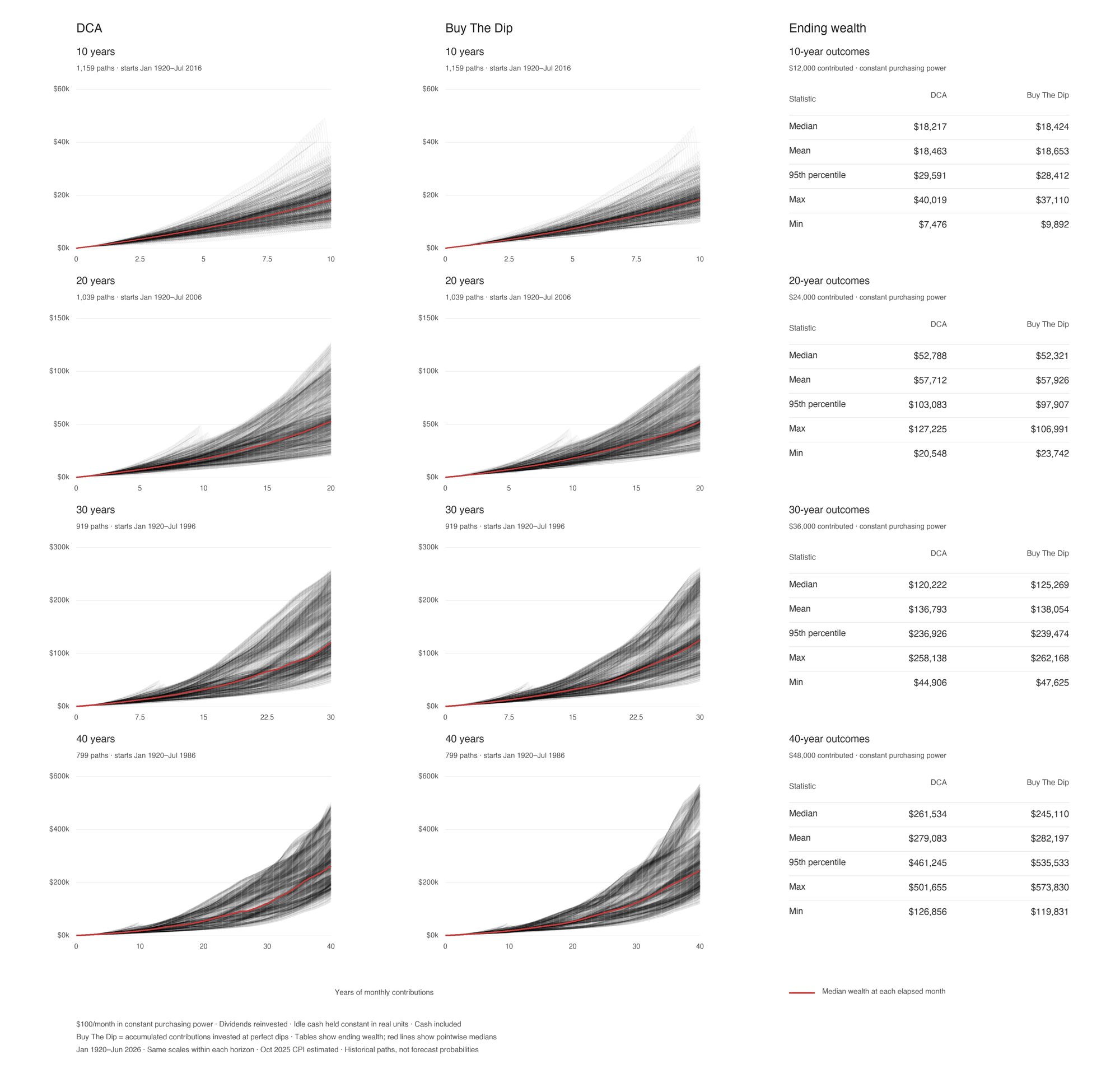
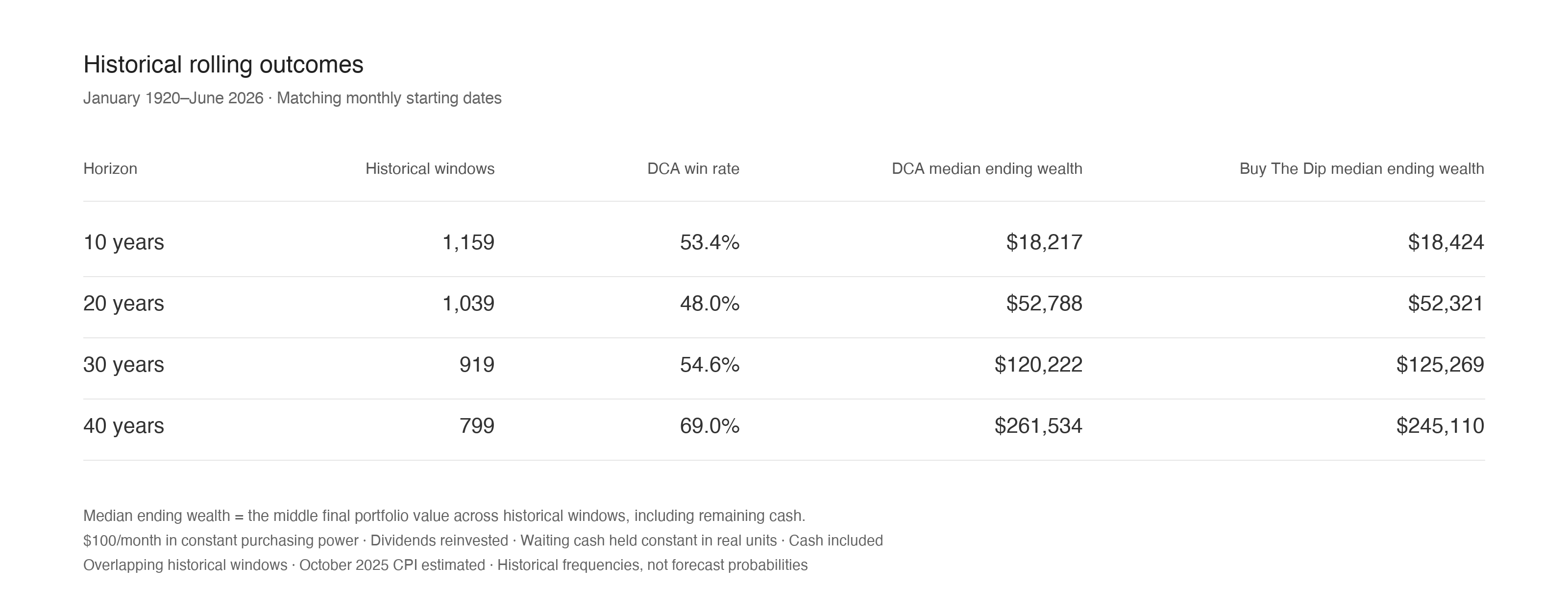
By extending the dataset to Mid 2026, God loses ~70% of the time over a 40 years period
Empirical evidence does suggest dollar-cost averaging tilts the odds in our favor over a really long period of time.
But many people do not have 40 years.
If we look at 10 year, 20 year or 30 year horizon. results seem to be 50-50. DCA may not necessarily beat buying at every dip.
I am not suggesting we should be timing the market, since we can only the dip on a hindsight. But simply saying DCA outperforms buying the dip over a long period, may simply not be true. Because 30 years is also a really long period.
What i didn't like about the backtest Nick & I have done so far is the treatment of cash. Cash is idling and not earning interest.
Totally unrealistic.
Second Backtest (Idling cash earns interest)
The market may rally for an extended period which could result in idling cash for a long period. We should take interest more seriously.
Thanks to professor Aswath Damodaran, we have the historical 3M T-Bill to use as reference. I thought 3M T-Bill might be a good proxy for idling cash.
I've also adjusted cash for inflation to remain consistent with equity, as it was computed on real return basis
Results
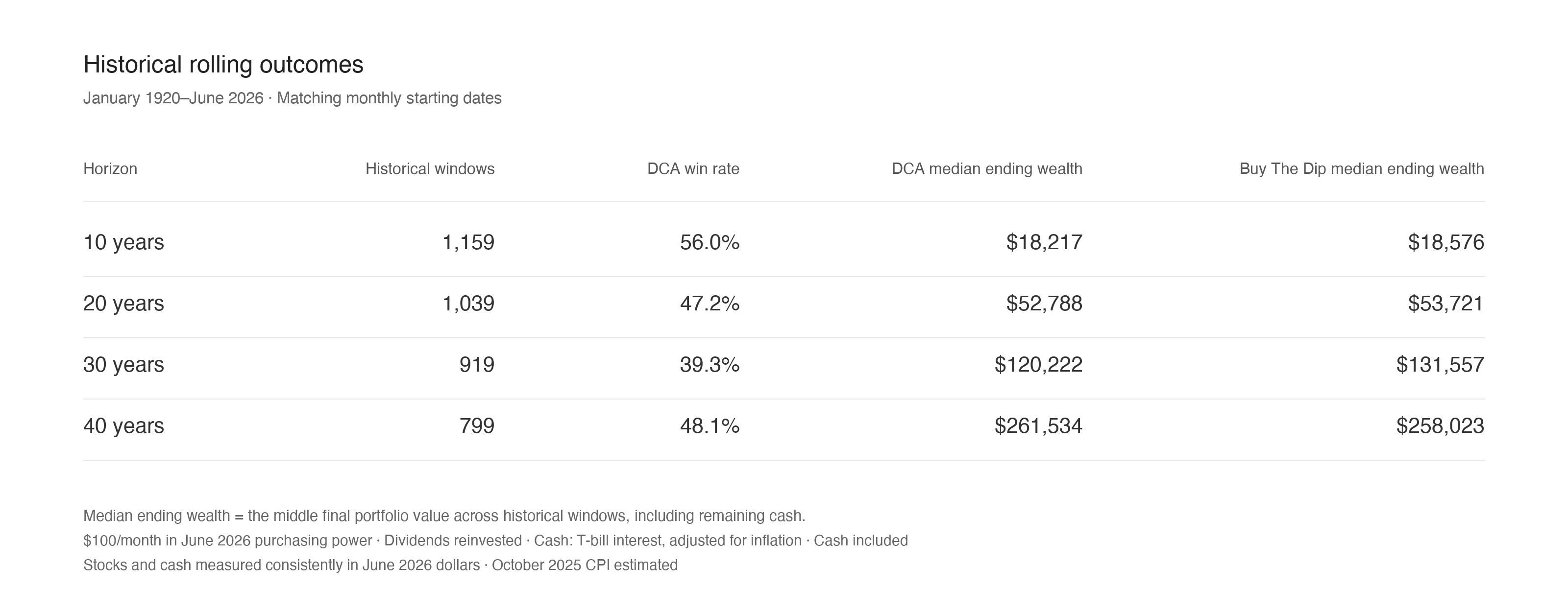
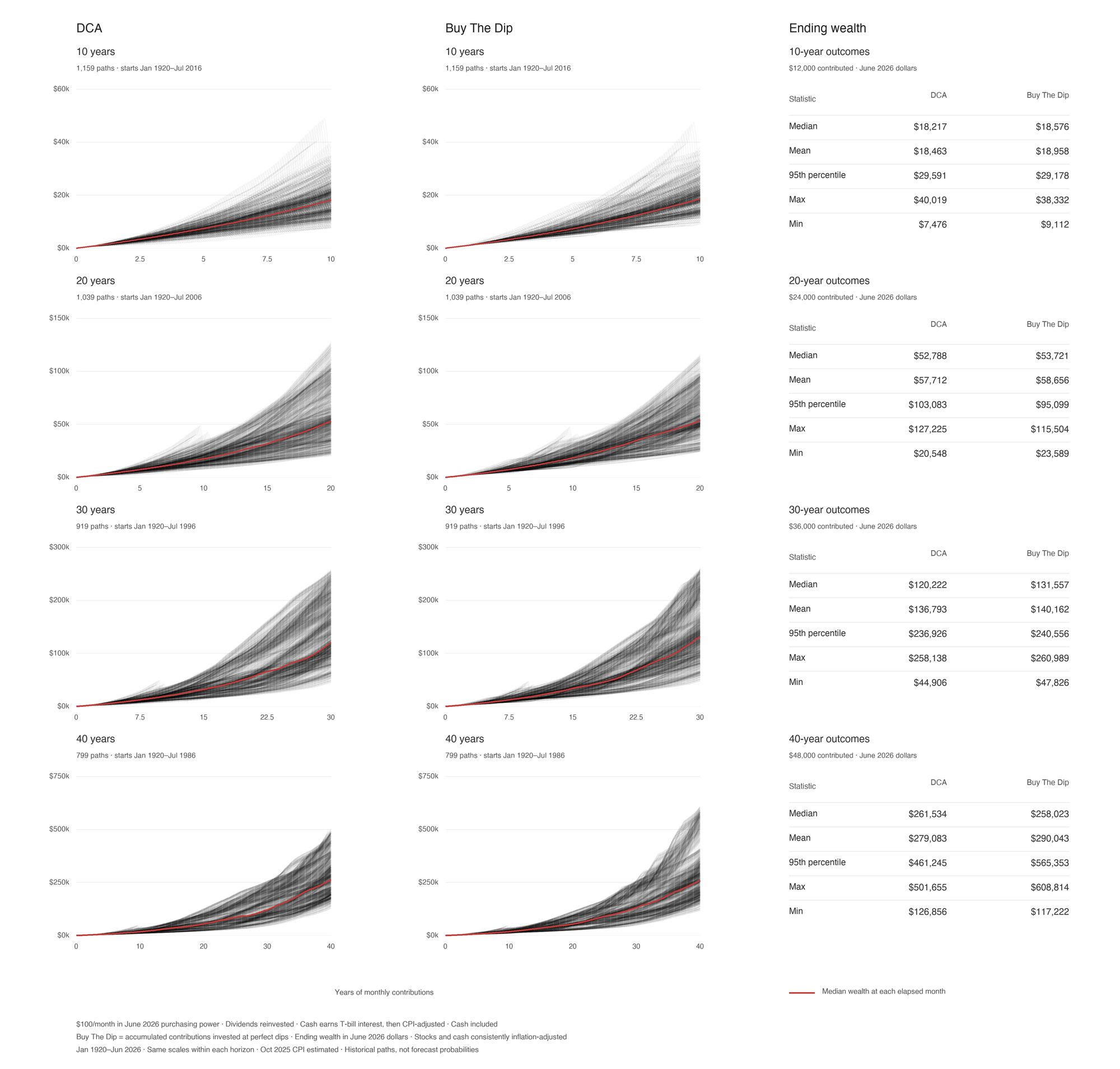
This backtest looks rather interesting.
- DCA win rate fell from 69% to 48.1% over the 40 year horizon
- DCA win rate also fell significantly over 20 year and 30 year horizon
- Buying the dip seems to yield better win-rate over 20, 30 and 40 years time horizon
- While buying the dip wins 51.9% of forty-year windows, its median ending wealth is $258,023, slightly below DCA’s $261,534
- In other time horizon, buy the dip saw increase of median end wealth
What does this mean for investor?
- Buying the dip needs cash optimisation to do better than dollar cost averaging
- What we do with our idling cash makes a meaningful difference
- I'd argue because of accumulated interest, an investor war chest grew meaningfully when interest rate environment is ideal
- Just because data suggests buying the dip yields a better outcome, does not mean it can be done. This are backtested with perfect hindsight.
Now that we know dollar cost averaging is not that almighty and God can win. I wanted to find out how buying the dip might alter an investor's experience and how buying the dip can be rule-based
Volatility & Drawdown : DCA vs Buy the dip
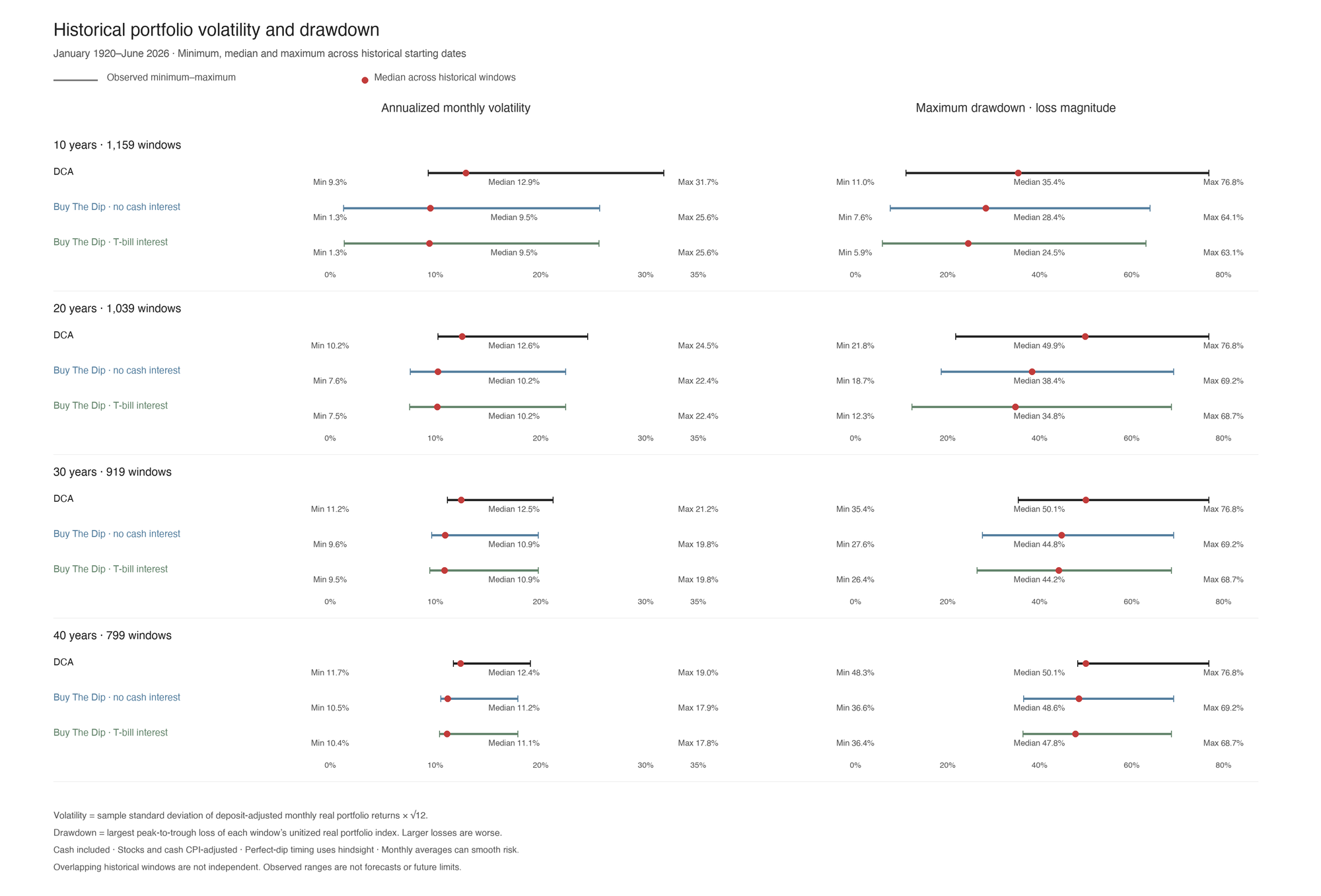
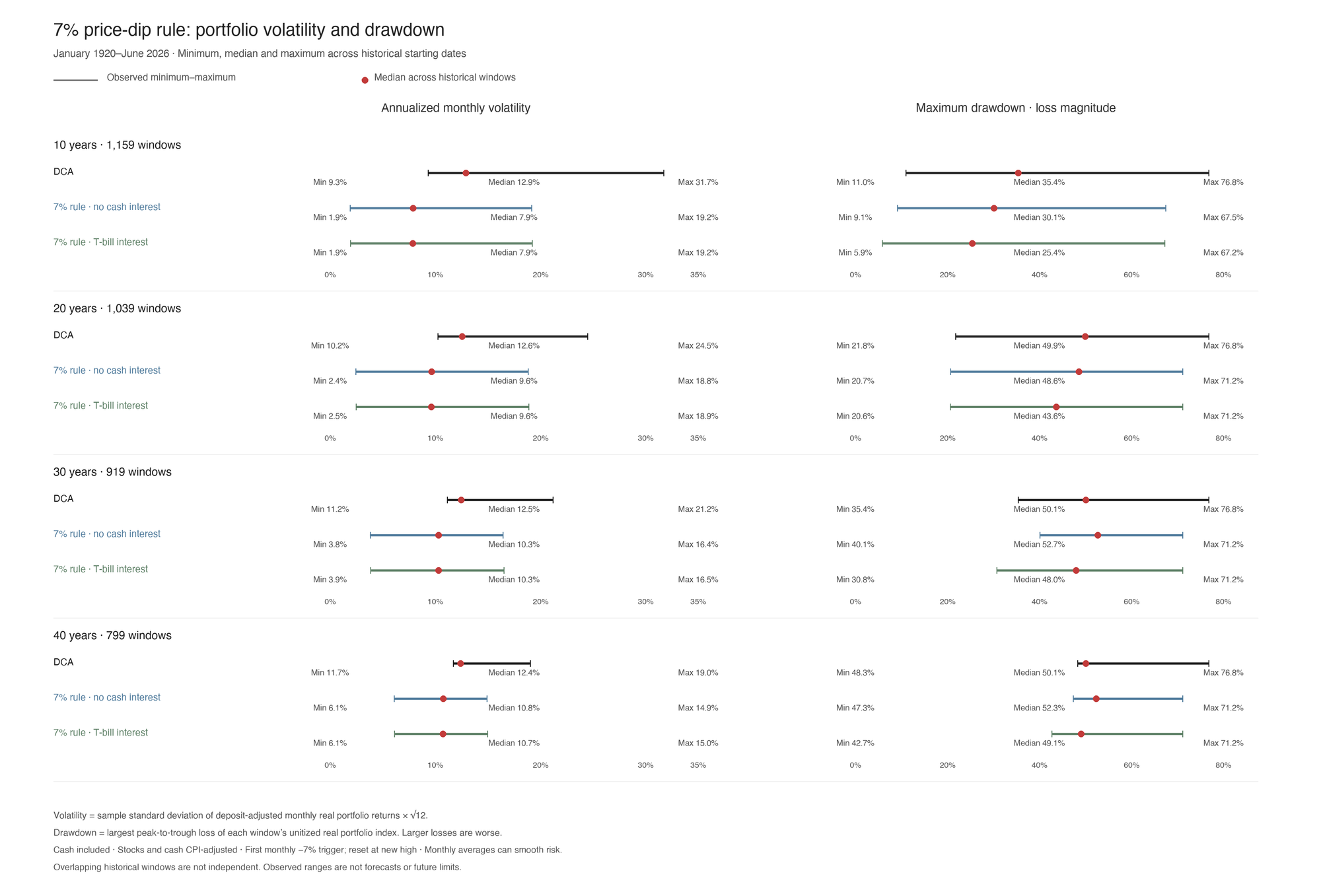
One of the biggest things affecting investor experience is drawdown. When the market is down by 20-30%. It's going to affect someone emotionally. when the market goes down even further, 60% to 70%, some investors might question their decision, and, as a result, panic sell.
When I first saw this result: the maximum drawdown is 60% to 70%. I was taken aback. Yes, we have all heard about the global financial crisis. It's nothing compared to the Great Depression, where the max drawdown was much worse.
Food for thought, will I, as an investor and as a financial planner, be able to be emotionally strong to weather this drawdown?
If you look at these findings, something is quite clear: if we do have the crystal ball of God, median portfolio volatility and drawdown can be brought down.
Overall, buying the dip will marginally reduce an investor negative experience if successfully implemented.
Can buying the dip be implemented with rules?
Up to this point, buying the dip simply meant buying at the lowest point. unfortunately, nobody will know when the lowest point is.
What we can do is to set rules to buy when price retraces from its all-time high.
These table summarised all the dips God has bought
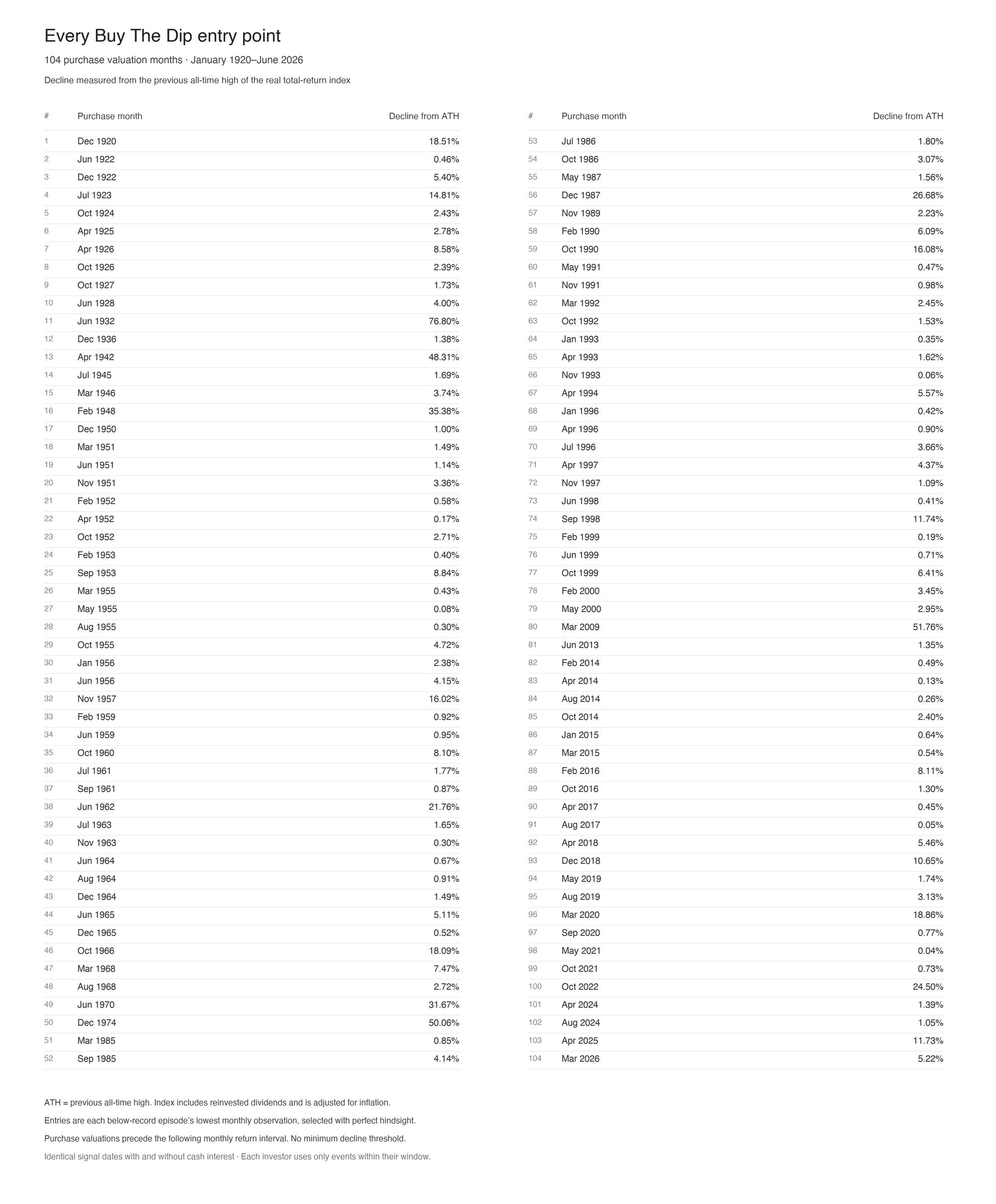
The average retracement from all-time high is 6.69%.
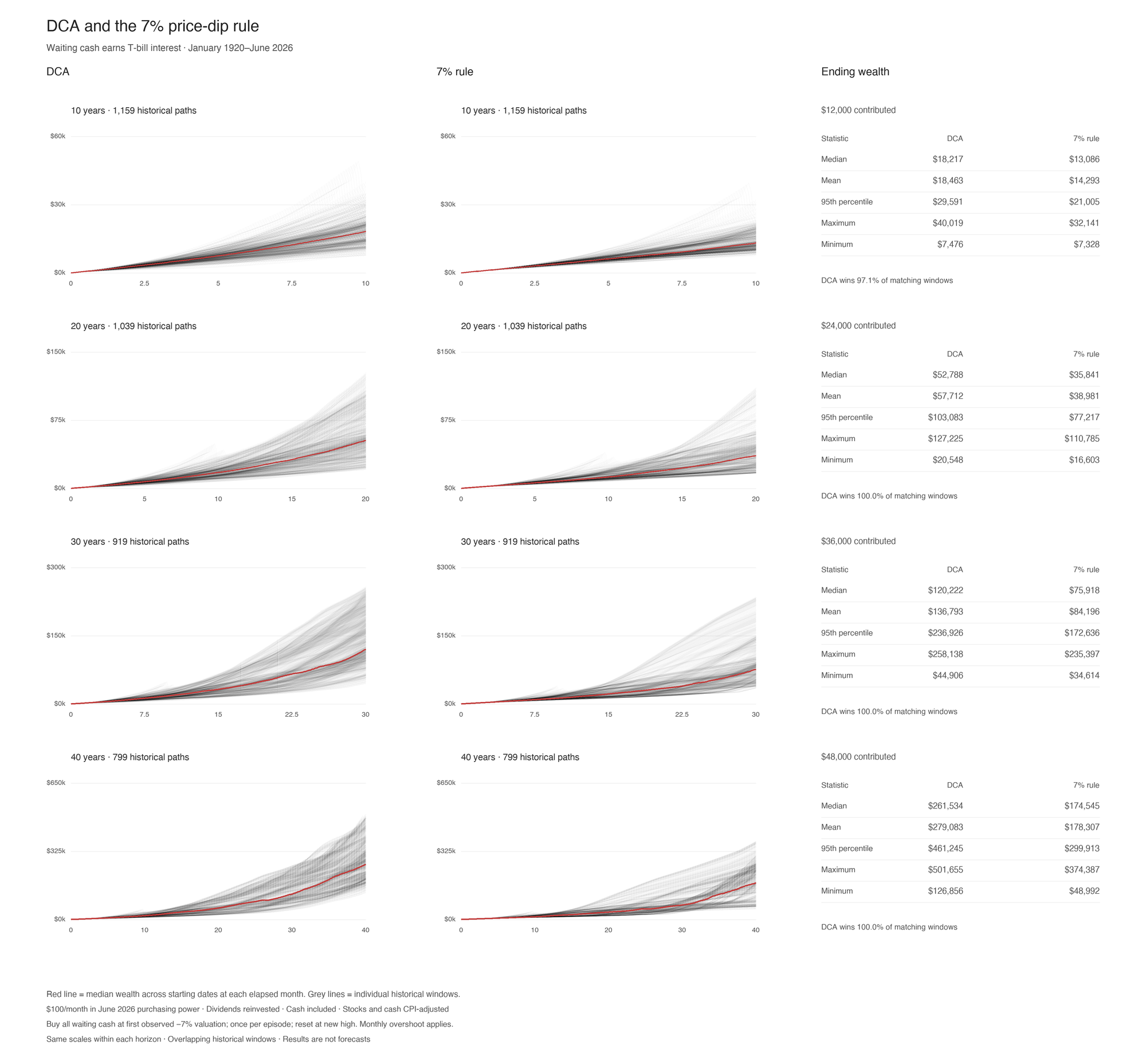
For the fun of it, I'm set the rule of 7%. An investor would buy the dip at every -7% from all time high by deploying all idling capital. The strategy makes another purchase only after the S&P 500 regains its previous record and subsequently falls by at least 7% again.
Results
Buying the dip only at -7% produced a significantly worse ending wealth than dollar cost averaging.
While volatility came down because of a good portion of portfolio remained in cash, returns was reduced as well.
Buying the dip do not have a meaningful impact on drawdown reduction.
A logical explanation might be buying the dip affects the earlier years of an investment period. Over a longer term, it no longer offer any cushion against major drawdown.
To be fair, I wasn't expecting anything different from conventional wisdom, but it's good to know for sure that this rule have failed horribly.
Conclusion
My study explored a previous study and the results shows that God can beat dollar-cost averaging if he doesn't leave cash idle.
My Biggest takeaway
There's always this monkey in my head, that says if you had perfect hindsight, you will be able to get a significantly better result as an investor. When I first came across the article, "even god cant beat dollar-cost averaging." I accepted the findings. It sounded fairly convincing. But somehow, I still cannot believe that God cannot beat down cost averaging.
I guess this study proves this monkey right. God wins.
But knowing that this monkey is right doesn't change the fact that I am not God and I do not have perfect hindsight.
So, I'll still stick with dollar-cost averaging which evidently tilt the investment odds to my favour.
Disclaimer : I may have made a mistake with nick's study or mine and i welcome feedbacks to improve my work
Have a good day!
Member discussion