How a Free Power Bank Doubled Your Investment
The Reciprocity Effect
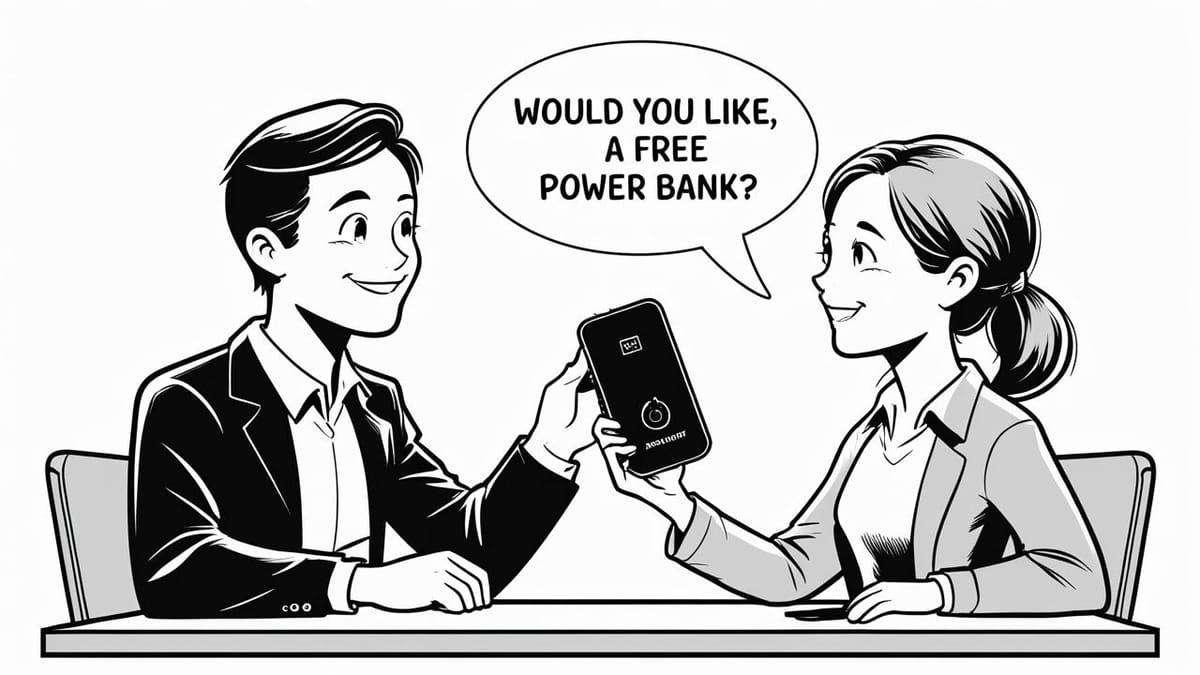
Did you know that you are inclined to spend twice as much after receiving a gift?
This insight comes from the Classic Coca-Cola experiment by Dennis Regan, a professor from Cornell University, in 1971.
The results showed the power of giving.
In the condition where Joe did not give the participant a soda, the degree to which they liked Joe influenced how many raffle tickets they bought. But in the condition where Joe did give a soda, participants bought twice as many tickets as the no-soda condition, regardless of how much they liked Joe.
Gifting, quite often a power bank, is a common phenomenon at many insurers roadshows.
Does it really get people investing twice as much into an investment plan? I’ll leave you to decide.
What I do know is for every satisfied customer, there’s bound to be a disgruntled one.
A quick scroll through Reddit SingaporeFi shows buyer’s remorse is a weekly affair. The latest post: “Parents Coaxed By Doorknock Agent To Purchase ILP Amounting To 200K.”
And here’s something to notice, people who speak up are often the outspoken ones.
It led me thinking, are majority of people somewhat satisfied or do they simply choose to stay silent?
Expectations towards Investment
How is it that two people can buy the same investment plan but feel so differently about it?
Person A : Expresses buyer’s remorse
Person B : Satisfied with their investment
If a product is objectively bad, it’s unlikely that both would buy it or both would likely regret it later.
Clearly, the product was acceptable to one of them. This must mean they had different expectations.
Person A : My situation could have been better if I invested elsewhere
Person B : My situation has improved compared to me not investing
As the saying goes, comparison is the thief of joy!
If we compared only to our “before”, we’d probably be much happier!
But here’s the bigger problem
If there’s objectively a better alternative, then Both A & B have made a sub-optimal life decision.
They might both be better off investing their money elsewhere.
Perhaps, people don’t make decisions that are objectively in their best interests.
Instead, people make decisions based on what they perceive to be the best.
Person A : Was exposed to new information, altering their perception, leading to remorse
Person B : Hasn’t been exposed and remains satisfied
This difference in perception often comes down to who we listen to.
Why We Trust Advisors (and Often Get It Wrong)
Many Singaporeans make financial decisions along with their financial advisors, bankers and insurance agents.
They are also key sources of information. To a large extent, we trust them.
Have you wondered, why do you trust your financial advisor?
Michelle and Dennis Reina, trust-building experts, found that trust is built around three critical areas: Character, Communication, Competence.
We trust someone because:
- They behave with integrity and act in our best interest (character).
- They are transparent and make us feel safe (communication).
- They are capable and get things done (competence).
In financial services, I believe the logical order should be:
1. Competence
2. Character
3. Communication
First, find people who are capable.
Then, narrow down to those with the character to act in your best interest.
Finally, if possible, choose someone who communicates well.
In reality, the order is often reversed
1. Communication
2. Character
3. Competence
“I prefer to work with people who communicate best with me. As a result, I trust this person. Hopefully, this person can help me reach my goals.”
There’s also a big misconception that being licensed means being competent.
That’s far from the truth.
Just because I graduated from culinary school does not make me a Sushi Chef.
Being licensed simply means a financial advisor is minimally qualified to get started.
In the absence of competence or character, we get situations of buyer’s remorse.
That’s why we must carefully assess and question the role of our advisors.
Are they here to sell or to advise?
If they lack character or competence, chances are they’re here to sell and you will have to do the heavy lifting yourself.
For those who want to take things into their own hands, it’s important to get educated and exposed.
For those who prefer to outsource, it’s critical to discern the quality of your advisors.
Conclusion
Ultimately, personal finance is a personal responsibility.
If you’re like me and weren’t born into wealth, we work to improve our life.
We trade time for money, and use that money to buy choices, experiences and memories.
Some of us are more privileged, able to invest and make smarter financial decisions.
By doing so, our money works for us so we don’t have to trade away as much of our life.
A sub-optimal money decision is really a sub-optimal life decision.
As Seneca said in On the Shortness of life :
“we do not receive a short life, but we make it a short one, and we are not poor in days, but wasteful of them”